At the end of any average year, every professional consultant might casually cast a glance over their previous predictions and commentary. Anyone brave enough to look back at their words 12 months ago will, for once, be allowed a complete pardon. Outside of Sci Fi writers, it is unlikely anyone could have come up with a 2020 scenario as witnessed.
Since commercial property impacts on every business across the UK and, without most realising it, every household also, we have sought to summarise and contemplate the commercial property market at this current point.
With ‘Brexit’ done but its effects (positive or negative) clouded by the pandemic and lockdown, the true impact won’t be felt for months – if not years. Thus far there have been no obvious portside issues; however, some of our logistics and haulier clients may comment differently and will be cursing much additional paperwork, and therefore administrative expense.
So, what did the economy, and specifically the commercial property market, learn from 2020?
The retail sector is by any definition in an obviously weak state and many big names have, and will continue, to fall by the wayside. Those with a good brand and an effective online channel have not necessarily prospered, but potentially survived, and this in turn will dictate how they see retailing post pandemic. It seems likely that as we return to any form of normality key regional shopping centres will see a return of most, if not all, of their customer base; however, this will arguably be linked more to people’s leisure time, and the ultimate ‘per head’ retail spend will be the real concern.
Even the most optimistic cannot deny that the average traditional High Street will take an enormous battering, and at the very least there will be a realignment of prime rentals, and the bigger future picture is likely to need strong planning and regeneration leadership, both regionally and nationally. However, in our key regional towns such as Bishop’s Stortford and Chelmsford the positive signs are that the adjustment of rents and values is encouraging the possible return of independent retailers and, to that end, the secondary shop market still remains relatively busy.
In the office sector, there is as much professional discussion as dominates the retail sector. The principal (and as yet unanswered) question in our region is effectively what will become of the central London office market? Has the drive toward working from home, and the consequence of less travel, etc, made employees and companies re-think matters entirely, or are many businesses losing the collaborative approach found only by people working together? There is also a significant question which is whispered quietly, namely that of employee productivity.
The most decisive factor may, however, be people themselves. Working from home is perfectly fine if you are fortunate enough to have sufficient space in your house, no young children and a reasonable environment. But, as we have seen during the second lockdown specifically, for many people working from home is tiresome, stressful and can potentially lead to some mental health issues. Therefore many employees (and bosses) may decide that, given the opportunity, they would sooner work in a workplace, and live in a home space.
At the current time, whilst it is obvious to say there is very little activity in the office sector; our active working region has in fact never been over supplied with office space, in part due to extensive PDR conversions over the last decade. There is, therefore, the possibility that if less (or no) London presence is required by some companies and they can operate at lower densities (with less public transport use) regionally, we may begin to see an uptick in office demand in the key towns around the M25. It is clear, however, that only the best office space will be in demand or viable, with bigger companies likely to seek only opportunities with clear floor plates which allow for more generous employee spacing than perhaps was the norm pre-Covid.
With continued strength in the residential market, we would anticipate that unsuitable or aging office stock will continue inextricably heading towards the PDR route.
The resilience, and ever-onward march, of the industrial and logistics sector took even seasoned specialists slightly by surprise as we entered the first lockdown. Clearly the majority of warehouse occupancy uplift in 2020 was internet supply based, having a direct negative impact on the retail sector as discussed above. The general belief is that some ‘High Street’ retail will never recover from the surge in internet shopping now that people have become used to it, and there is a rational argument that says the pandemic pushed internet retailing forward by five or ten years in less than twelve months.
Principally, the whole of the UK realised in 2020 what many property professionals already knew: just about everything you buy has either been made in a factory or stored in a warehouse. The missing link in that is now that the physical shop, where you originally went to ‘look’ at the product, has in many cases been removed from that equation.
The result is therefore the current boom time for industrial and logistics which coincided with a sector not over-supplied in any event. There are very limited numbers of vacant warehouse/industrial buildings in all size brackets and this has led to an increase in new development proposals, but also the exponential rise in demand for industrial and logistics investments where they are seen as a safe haven for money, both private and fund. In this particular sector there are published UK analysis report headlines, openly proclaiming that 2020 saw the largest take-up of warehousing space ever, and with investment yields at an all-time low.
Industrial and logistics rents have undeniably continued to push upwards across the whole of our region and there is a definitive radial effect from London in terms of both building availability and occupation cost. The net result of all the above is that in some locations we are seeing commercial land being arguably more valuable per acre than for residential development, a scenario once considered unthinkable.
The commercial property occupier, more than ever, needs sound advice whatever sector, and whether expanding, shrinking or investing. The market place is no longer insular or town specific: regional and national situations impact everyone and good professional property advice is a must.
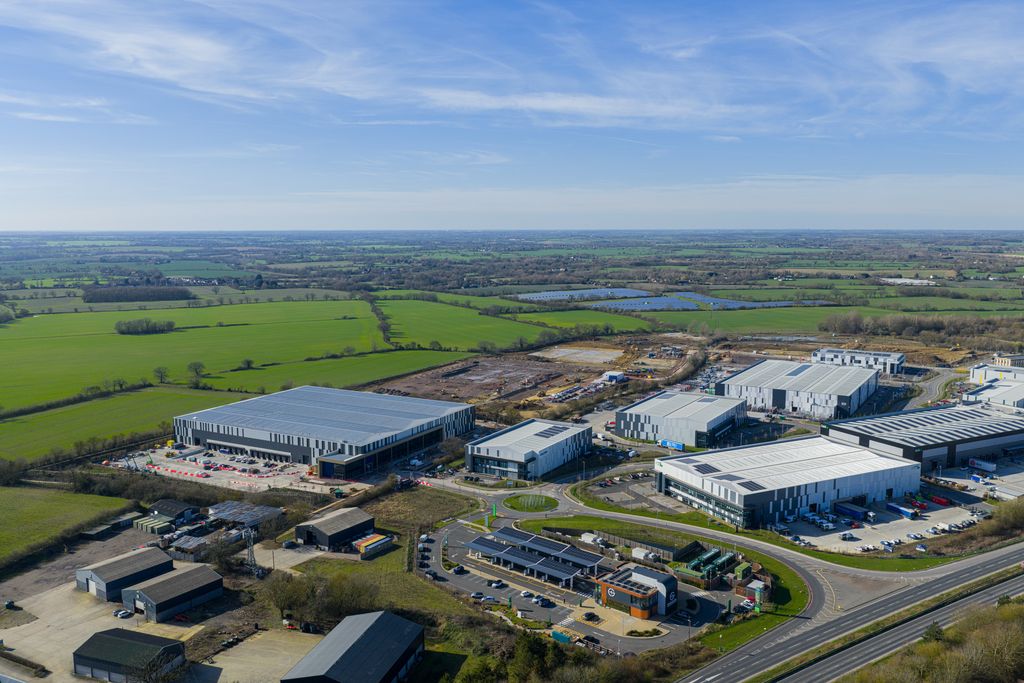
In spite of the above (or possibly because of), Coke Gearing Consulting had an extremely productive 2020 with key development schemes like Horizon 120, Braintree, achieving a number of pre-lets and pre-sales, with work now commencing on site. At Ransomes Europark, Ipswich, a significant pre-let and subsequent investment sale was completed. Acquisition advice was given to corporate clients in respect of two major Braintree investments which concluded in December, all alongside more ‘mundane’ agency and professional jobs which are just as important collectively. With a solid footing and an eye to the future, the company has expanded both physically and geographically with the addition of Paul Fitch and Will Brown.